

Can I Claim for Pothole Tyre Damage in the UK?
If you have just hit a pothole and damaged a tyre, the honest answer is: you may be able to claim for pothole tyre damage, but it is not automatic. Whether you get your money back depends on who is responsible for the road, whether they knew about the defect, and how much evidence you can put in front of them. This guide walks through the pothole tyre damage claim process from the moment you hit the pothole through to what happens if the council says no.
We are a mobile tyre fitting team, so we see the aftermath of pothole damage regularly. This guide is based on that experience and on current UK guidance, but it is not legal advice. Always check the relevant authority’s own claims procedure before relying on anything below.
What Is Pothole Tyre Damage?
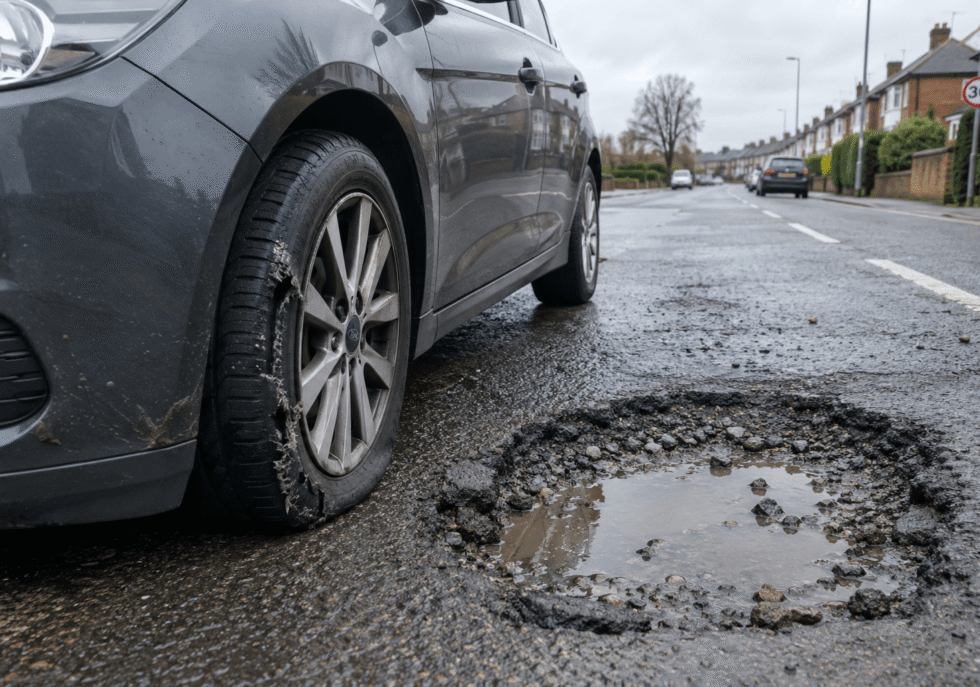
Hitting a pothole at speed can do more than just give you a jolt. Depending on the depth of the pothole, your speed, and the angle of impact, a single strike can cause:
- A punctured tyre
- Sidewall damage or a bulge
- Sudden or gradual loss of air pressure
- A bent alloy or steel wheel
- Wheel alignment problems
- Suspension or steering component damage
Some of this is obvious straight away, a tyre going flat on the spot is hard to miss. Other damage, such as a hairline crack in a wheel or a knocked-out track rod end, can take days to show up as a vibration, a pull to one side, or uneven tyre wear. Not every pothole strike causes hidden damage, but if something feels different about how the car drives afterwards, it is worth getting it checked rather than assuming it will settle down.
If you suspect anything more than tyre damage, pull over somewhere safe and stop driving on it. Driving on a badly bent wheel or a damaged tyre can turn a repair bill into a much bigger one, or cause a blowout.
Can I Claim for Tyre Damage From a Pothole?
You may be able to claim for pothole tyre damage if the highway authority responsible for that road can be shown to have known, or reasonably should have known, about the defect and failed to deal with it in time. Compensation is not automatic, and each claim is assessed on its own facts.
This is the core of a pothole tyre damage claim. In England and Wales, highway authorities have a duty under the Highways Act 1980 to maintain the roads for which they are responsible. But that same Act gives them a defence: if the authority can show it ran a reasonable system of inspection and repair, it does not have to pay out even where a pothole clearly caused the damage. Scotland and Northern Ireland have their own separate legislation covering the same basic principle.
In practice, this means the strength of a claim for tyre damage from pothole damage rests on things like:
- Whether the pothole had been reported before your incident
- How long the defect had existed
- Whether the road was inspected at a reasonable frequency for its classification
- Whether the pothole met the authority’s own criteria for an urgent repair
- The quality of the evidence you can provide
- Whether you contributed to the damage, for example by driving too fast for the conditions
None of this guarantees a payout. A well-documented claim against an authority with a poor inspection record has a reasonable chance. A vague claim with no photographs, against an authority that inspected the road two days earlier and found nothing, is unlikely to succeed.
Who Is Responsible for Pothole Damage?
Not every UK road is looked after by the same organisation, so identifying the correct highway authority is one of the most important early steps.
Local Roads
Most B-roads, minor A-roads and residential streets are maintained by your local council, county council or unitary authority. This is where the bulk of pothole tyre damage claim activity happens, since these roads make up the majority of the network.
Motorways and Major A Roads
In England, motorways and many major trunk roads are managed by National Highways rather than the local council. If your pothole was on one of these roads, your claim needs to go to National Highways, not the council. Do not assume the council is responsible just because the road runs through their area.
Scotland, Wales and Northern Ireland
Road maintenance responsibility differs across the UK:
- In Scotland, local roads are managed by the relevant council under the Roads (Scotland) Act 1984, while trunk roads and motorways are managed by operating companies such as BEAR Scotland or Amey, depending on the region.
- In Wales, local councils look after most roads, while Traffic Wales manages the trunk road and motorway network.
- In Northern Ireland, the Department for Infrastructure is responsible for the entire road network, so claims go through one central route rather than council by council.
If you are unsure who maintains the road where the damage happened, check GOV.UK or the relevant national government’s roads guidance before submitting anything.
When Might a Council Be Liable for Pothole Damage?
This is the section most searches for “tyre damage pothole council” are really asking about.
Under Section 41 of the Highways Act 1980, highway authorities in England and Wales have a duty to maintain roads that are maintainable at public expense. But under Section 58, they have a statutory defence if they can prove they took reasonable care to keep the road safe. In practice, that usually comes down to whether the authority operated and followed a reasonable inspection and repair system.
Councils typically look at:
- Whether the pothole had already been reported and, if so, when
- Whether it was found during a routine inspection and, if so, whether the repair timescale for its priority category had been missed
- The size of the pothole against the authority’s own intervention criteria, often around 40mm deep on busier roads
- The classification of the road, since busy A-roads are generally inspected more often than quiet residential streets
- Any records showing the authority acted within its own published response times
An authority is not automatically liable just because a pothole existed. Many claims are rejected because the council can show it inspected the road recently and the defect either was not there or did not meet the threshold for urgent repair at that time. This is why evidence connecting the specific pothole, on the specific date, to your specific damage matters so much.
Pothole Tyre Damage Claim Process
Here is the pothole tyre damage claim process from start to finish.
Step 1: Stop Somewhere Safe
If you can, pull off the road safely before checking anything. Never inspect a tyre or take photographs from within a live traffic lane.
Step 2: Record the Exact Location
Note the road name, direction of travel, nearest junction or landmark, and postcode if you can. Dropping a pin in your maps app and taking a screenshot with GPS coordinates is a quick way to lock this in accurately.
Step 3: Photograph the Pothole
Take a wide shot showing the pothole in context, a mid-distance shot, and a close-up. If you have something for scale, such as a coin or a tape measure, use it, since dimensions can matter later.
Step 4: Photograph the Damage
Photograph the tyre, any sidewall bulge or cut, the wheel, and anything else that looks affected.
Step 5: Keep Evidence
Hold on to the damaged tyre and wheel where practical, along with any repair invoice, replacement invoice, recovery or towing receipt, and inspection report from a garage or mobile tyre fitter.
Step 6: Report the Pothole
Report it to the responsible highway authority as soon as you reasonably can. This is separate from making a compensation claim, but it creates an official record and a reference number.
Step 7: Identify the Responsible Highway Authority
Confirm whether the road is managed by the local council, National Highways, or one of the devolved equivalents before you submit anything, so your claim goes to the right place first time.
Step 8: Submit the Claim
Most authorities have their own online claims form or a dedicated highways claims team. You will usually need to provide the incident date and location, a description of the pothole and the damage, your repair costs, and your supporting evidence. Every authority’s process differs slightly, so follow their specific instructions rather than assuming a generic form will work everywhere.
Step 9: Wait for the Authority’s Response
The authority will typically check its inspection and repair records, any previous reports of the same defect, and the circumstances you have described before responding. This can take weeks rather than days.
Step 10: Consider Further Action if Rejected
If the claim is rejected, you can ask for the reasoning in writing, review your evidence, and decide whether to pursue it further, including through the small claims court in England, Wales and Scotland, or through Northern Ireland’s separate process. There is no guarantee of success at this stage either.
What Evidence Do I Need for a Pothole Claim?
Good evidence is what separates a claim that gets taken seriously from one that gets a template rejection letter.
- Photographs of the pothole and the damage are the foundation of most claims, showing size, depth and location.
- The exact location helps the authority identify the correct stretch of road and cross-check it against their inspection records.
- Date and time establish when the incident happened, which the authority will compare against its own inspection and repair history.
- Dashcam footage, if you have it, can independently confirm the pothole and the moment of impact.
- Witnesses are useful if someone else saw the incident or the state of the road.
- Repair and replacement receipts demonstrate the actual financial loss you are claiming.
- A vehicle inspection report from a garage or mobile tyre fitter can document the damage professionally, which carries more weight than a driver’s own description.
- Evidence of previous pothole reports, whether from you or from public reporting platforms, can help show the authority had earlier notice of the defect.
Do not exaggerate or alter any of this. An inflated or fabricated claim can be identified and will damage your credibility with the authority or your insurer.
How to Claim for Tyre Damage From a Pothole
In practical terms, the process for how to claim for tyre damage from pothole damage looks like this:
- Identify the road and confirm who maintains it.
- Collect your photographic and documentary evidence.
- Report the pothole through the authority’s official channel.
- Document the vehicle damage, ideally with a professional inspection.
- Get quotes or invoices for the repair or replacement.
- Follow the specific authority’s claims procedure, rather than a generic template.
- Submit your claim with all supporting evidence attached.
- Keep copies of everything you send and receive.
- Read any response carefully before deciding on next steps.
Each authority runs its own claims process, so always check their current form and requirements rather than relying on secondhand instructions.
Can I Claim for Flat Tyre Damage From a Pothole?
A flat tyre is one of the most common outcomes of hitting a pothole, whether through a straightforward puncture, a split sidewall, or a bent wheel that will not hold air. A claim for flat tyre damage from pothole damage can potentially cover replacement or repair costs, but you still need evidence linking the flat specifically to that pothole, on that road, on that date.
This matters because not every flat tyre is pothole-related. A slow puncture from a nail, or a tyre that was already close to the end of its life, can look similar to pothole damage on the surface. A professional inspection that records the type and location of the damage, alongside your photographs of the pothole itself, gives the claim far more weight than a description alone.
Can I Claim for Pothole Wheel or Alloy Damage?
Pothole impacts do not stop at the tyre. Alloy wheels can crack or bend, steel wheels can dent, and the shock can travel into the suspension and steering, sometimes affecting wheel alignment or wheel bearings.
Get the car checked by a professional if, after a pothole strike, it:
- Pulls to one side
- Vibrates through the steering wheel or seat
- Feels different when cornering or braking
- Loses tyre pressure over the following days
- Makes a new noise over bumps
We are not going to diagnose a specific mechanical fault without seeing the vehicle, and neither should any guide you read online. If in doubt, get it looked at.
Pothole Tyre Damage Insurance
Whether your insurance covers pothole tyre damage insurance claims depends entirely on your policy. Comprehensive car insurance may cover pothole-related tyre and wheel damage as accidental damage, but this is not universal, and third-party-only policies generally will not cover it at all.
Before claiming on insurance, it is worth weighing up:
- Your policy excess, which may be more than the cost of a single tyre replacement
- Whether the claim could affect your no claims discount, even if the incident was not your fault
- Whether your policy has a specific tyre or wheel exclusion
- Whether the insurer would want to pursue the highway authority on your behalf, known as subrogation
For a relatively low-cost tyre replacement, many drivers find it makes more sense to pay for the repair and pursue the highway authority directly, rather than involve their insurer. This is a decision worth thinking through carefully, and your insurer can confirm exactly how your policy would treat it before you commit either way.
Council Claim vs Insurance Claim
| Factor | Council / Highway Authority Claim | Insurance Claim |
|---|---|---|
| Who you claim from | The responsible highway authority | Your insurer |
| Main question | Whether the authority was liable | Whether your policy covers it |
| Evidence needed | Pothole and damage evidence | Damage evidence and policy terms |
| Excess | Not usually applicable | May apply, and can exceed the repair cost |
| No claims discount | Not normally affected | May be affected depending on your insurer |
| Outcome depends on | Liability and inspection records | Your policy wording |
| Process | The authority’s own claims procedure | Your insurer’s claims process |
Individual policies and authority procedures vary, so always check the specifics rather than assuming either route will work the same way twice.
What If the Council Rejects My Pothole Claim?
Rejection is common, and it does not always mean the claim had no merit. Councils typically reject pothole tyre damage claims because:
- They had no prior report or knowledge of the defect
- Their inspection records show the road was checked recently and reasonably
- The pothole did not meet their intervention criteria at the time
- They dispute the circumstances you have described
- The evidence supplied does not clearly connect the damage to that specific pothole
- Another authority, not them, is actually responsible for that stretch of road
If your claim is rejected, read the reasoning carefully, request clarification if it is unclear, and check that you contacted the correct authority in the first place. Some authorities have an internal review or complaints process. For a significant claim, independent legal advice may be worth the cost, but an appeal is not guaranteed to succeed.
What If I Did Not Photograph the Pothole?
Not having photographs makes a claim harder, but not necessarily impossible. Dashcam footage, witness accounts, a professional vehicle inspection report, your recollection of the exact location, and any existing reports of the same pothole from other drivers or from public reporting platforms can all help build a picture. Photographs taken later may not accurately reflect the pothole’s size or depth at the time of your incident, so be upfront about when they were taken if you use them.
What If the Pothole Has Already Been Repaired?
A pothole being fixed afterwards does not automatically rule out a claim, and it does not prove the authority was negligent either. What it does mean is that any evidence you collected at the time, your own photographs, dashcam footage, witness details, the exact location, date and time, and your repair invoices, becomes even more important, since the physical evidence at the roadside is now gone.
Reporting a Pothole
Reporting a pothole and making a compensation claim are two different things. Reporting alerts the responsible highway authority to the defect, helps establish a timeline of when they were made aware of it, and protects other road users from hitting the same pothole. It does not, by itself, secure you any compensation.
Use the official reporting route for the correct authority, whether that is your council’s own online form, GOV.UK’s reporting service, National Highways for motorways and major A-roads in England, or the equivalent devolved service in Scotland, Wales or Northern Ireland. Keep the reference number you are given, as it can support a later claim.
How to Reduce the Risk of Pothole Tyre Damage
You cannot control the state of every road, but a few habits reduce the chances of damage:
- Keep a safe following distance so you can see potholes in good time
- Slow down on roads you know are in poor condition, particularly after heavy rain or frost
- Check your tyre pressures regularly, since correctly inflated tyres cope with impacts better than under-inflated ones
- Avoid swerving suddenly to dodge a pothole if it puts you into the path of another vehicle
Final Thoughts
You may be able to claim for pothole tyre damage in the UK, but compensation is never automatic. The strength of a claim depends on the responsible highway authority, the condition and history of the pothole, whether they knew or should have known about it, and the quality of the evidence you can provide.
The practical steps are straightforward even if the outcome is not guaranteed: stay safe, document the pothole and the damage thoroughly, identify the correct authority, keep your repair evidence, and follow their specific claims process. If you need the tyre sorted in the meantime so you are not stuck at the roadside, that is where we can help.
Common UK Questions About Pothole Damage Claims
Can I claim for a pothole damaged tyre?
Yes, potentially, if you can show the responsible authority knew or should have known about the defect. It is not guaranteed.
Will the council pay for my tyre?
Only if your evidence shows they failed to maintain the road reasonably. Many claims are successfully defended under Section 58 of the Highways Act 1980.
What if I did not take a photograph?
It makes things harder but not impossible. Dashcam footage, witnesses and inspection reports can help.
Does claiming affect my no claims discount?
It can, depending on your insurer and policy, which is why many drivers pursue the highway authority directly for smaller repairs instead.