

The 20p Tyre Test: How to Check Your Tyres in Ten Seconds
Written by the TyresFlow mobile fitting team. We check tread and swap worn tyres at the roadside every day, all over the UK.
You do not need a garage, a ramp or a mate who knows about cars. You need a 20p tyre test and about ten seconds per tyre.
It is the simplest check in motoring, and most drivers in this country have heard of it. What far fewer people know is what the result actually tells you, because it is not quite what you have probably been told. We will get to that bit, because it matters.
What the 20p test is
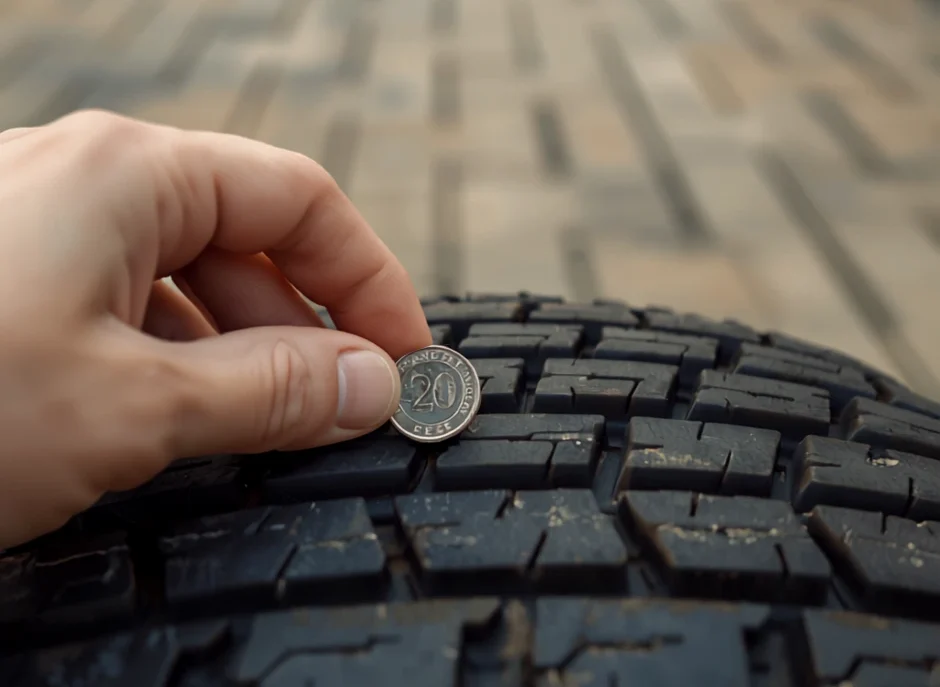
A 20p coin has a raised band running round the outside edge of it. Have a look at one now and you will see what we mean, it is that flat rim before the pattern starts.
That band happens to be a handy depth for checking tyres. Pop the coin into a tyre groove, and whether you can see that band or not tells you roughly how much tread you have got left. That is the whole idea. No tools, no cost, no faff.
How to do the 20p tyre tread test properly
Here is the 20p tyre tread test uk drivers can do on the drive in under a minute:
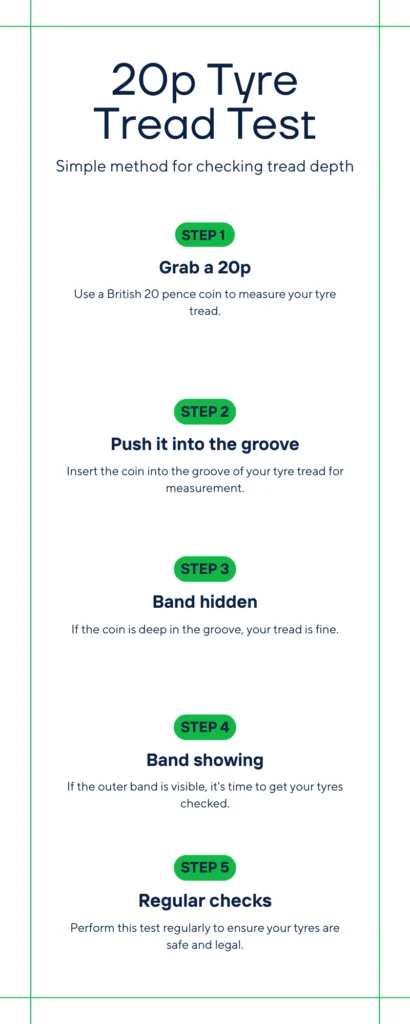
Step one. Park up somewhere flat and safe. Turn the engine off. If you want to check the front tyres properly, turning the steering wheel full lock makes the inner edge much easier to get at.
Step two. Take a 20p out your pocket. Any 20p will do, they are all the same.
Step three. Push the coin into one of the main grooves, the deep ones running round the tyre. Push it right in so it sits at the bottom.
Step four. Look at the coin. Can you see the raised outer band?
- Band hidden: you have got a decent amount of tread. Happy days.
- Band visible: your tread is getting low. Time to look at it properly.
Step five, and this is the one people skip. Do it again in at least three different spots around the tyre, and check the inner edge, the middle and the outer edge. Then do all four tyres.
That last step is where most people come unstuck, and we will explain why in a minute.
The bit most guides leave out
Right, here is the important part, and you will not find it on many websites. Almost every guide tells you the coin test checks whether your tyres are legal. That is not quite true.
The legal minimum tread depth in the UK is 1.6mm. But the raised band on a 20p coin is roughly 3mm deep. Those are not the same number, and it is not even close.
So what the test is actually telling you is whether you are above or below 3mm, which is the depth most tyre safety experts reckon you should be replacing at, not the legal limit you must not go under.
In simple words:
- If the band is hidden, you are above 3mm. You are legal and you have got proper wet grip. Nothing to worry about.
- If the band is showing, you are somewhere under 3mm. You might still be perfectly legal. But you are in the zone where your wet braking starts dropping off, and you want to get a proper measurement done.
This is genuinely useful to know, because it cuts both ways. Some drivers see the band and panic, thinking they are breaking the law when they are not. Others assume that because the test is about the legal limit, they can safely ignore it until the coin is nearly swallowed whole. Neither is right.
Think of the coin as an early warning, not a legal verdict.
| What you see | Roughly where you are | What to do |
| Band completely hidden | Above 3mm | Nothing. Check again in a couple of weeks |
| Band just starting to show | Around 3mm | Start budgeting for new tyres |
| Band clearly visible | Under 3mm | Get a proper reading with a gauge |
| Most of the coin visible | Close to or under 1.6mm | Do not hang about. Replace them |
Three mistakes we see all the time
We do this for a living, so we see the same slip ups over and over. Save yourself the bother.
Checking one spot and calling it done. This is the big one. Tyres almost never wear evenly. If your tracking is out, or you have been running the pressures low, the inside edge can be worn right down while the middle still looks grand. We have turned up to jobs where the driver swore blind their tyres were fine, because they had tested the middle of the tread. The inner shoulder was down to the cords. From the outside of the car, you could not see a thing.
Forgetting the back tyres. People check the fronts because that is what they can see when they walk up to the car. Rears wear too, especially on rear wheel drive cars, and every tyre on the car has to be legal in its own right.
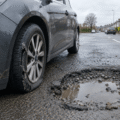
Doing it once a year and forgetting about it. A quick check every couple of weeks takes no time. Before a long run or a trip away, do it without fail. Tread does not wear off overnight, but a nail in the sidewall or a knock from a pothole can change things fast.
Better ways to check, if you want to be sure
The coin is brilliant for a quick look. If you want an actual number, you have got two other options.
Tread wear indicators. Look down inside the grooves and you will spot small raised bars of rubber. There is usually a little arrow or triangle on the tyre wall pointing to where they are. When the tread has worn down level with those bars, you are at the legal limit. No coin needed, and they are built into the tyre.
A tread depth gauge. A few quid from a motor factor or online. Push it into the groove and it gives you a reading in millimetres. If you want to know exactly where you stand rather than roughly, this is the one to get. Well worth the money if you are the sort who likes to stay on top of things.
What to do if your tyres are low
If the 20p coin tyre tread test uk drivers rely on has flagged something up, and a proper check backs it up, do not sit on it. Worn tyres are at their worst in exactly the weather this country gets most of the year.
You can book into a garage, sort a time, get there and wait about. Or you can have someone come to you and do it where the car already is, on your drive, outside work, or at the roadside if you have been caught short.
That second one is what we do. Our mobile fitters come out to you and usually have a fresh tyre on in 30 to 60 minutes, anywhere in the UK. No waiting room, no faffing about with courtesy cars.
If the coin has told you something you would rather not hear, get in touch and we will come to you and sort it.
Tread depth limits quoted here reflect UK law at the time of writing. Rules can change, so check gov.uk if you need certainty for your own situation.
The questions drivers actually ask us
Does the 20p test work on all tyres?
On normal car and van tyres, yes. On motorbike tyres it is less reliable because the tread pattern and the legal limit are different, the minimum for bikes is 1mm rather than 1.6mm.
Can I use a different coin?
People try all sorts. The 20p is the one that works because of that raised band. Other coins do not give you a usable reference, so stick with the 20p.
The band is showing. Am I breaking the law?
Not necessarily. You could be anywhere between just under 3mm and under 1.6mm. Get a gauge on it or have someone check it properly before you assume the worst.
My tyres passed the MOT a few months back, do I still need to check?
Yes. An MOT is a snapshot of one day. Plenty of tyres pass in spring with an advisory and are illegal by the following winter. If your last MOT mentioned tread, treat that as a nudge, not a clean bill of health.
The tread looks fine but the tyre looks a bit odd, does the coin cover that?
No. The coin only checks depth. Bulges, cracks, cuts or anything sticking out the tyre are separate problems and can be more urgent than worn tread. If you spot any of that, get it looked at rather than relying on a coin test.