

Tyre Tread Depth and UK Law: The Complete Driver’s Guide
Written by the TyresFlow mobile fitting team, who check and replace worn tyres at the roadside every single day across the UK.
Most drivers have heard “1.6mm” thrown about and know that bald tyres are bad news. But ask them what tyre tread depth actually means, whether their tyres are legal right now, or what happens if a copper pulls them over, and you get a shrug.
This guide sorts all of that out in plain English. No jargon, no waffle. Just what the law says, how to check tyre tread depth in about ten seconds, what it costs you if you get it wrong, and a few things about the famous 20p test that most websites conveniently leave out.
The short version
If you only read one bit, read this:
- The minimum tyre tread depth in the UK is 1.6mm for cars, vans and light trailers.
- It has to be 1.6mm across the middle three quarters of the tyre, all the way round.
- Below that, your tyre is illegal. Full stop.
- The fine is up to £2,500 and 3 penalty points per tyre. Not per car. Per tyre.
- Most tyre safety experts reckon you should actually swap your tyres at 3mm, not wait for 1.6mm.
Now the detail, because the detail is where drivers get caught out.
What is tyre tread, and why does the law care?
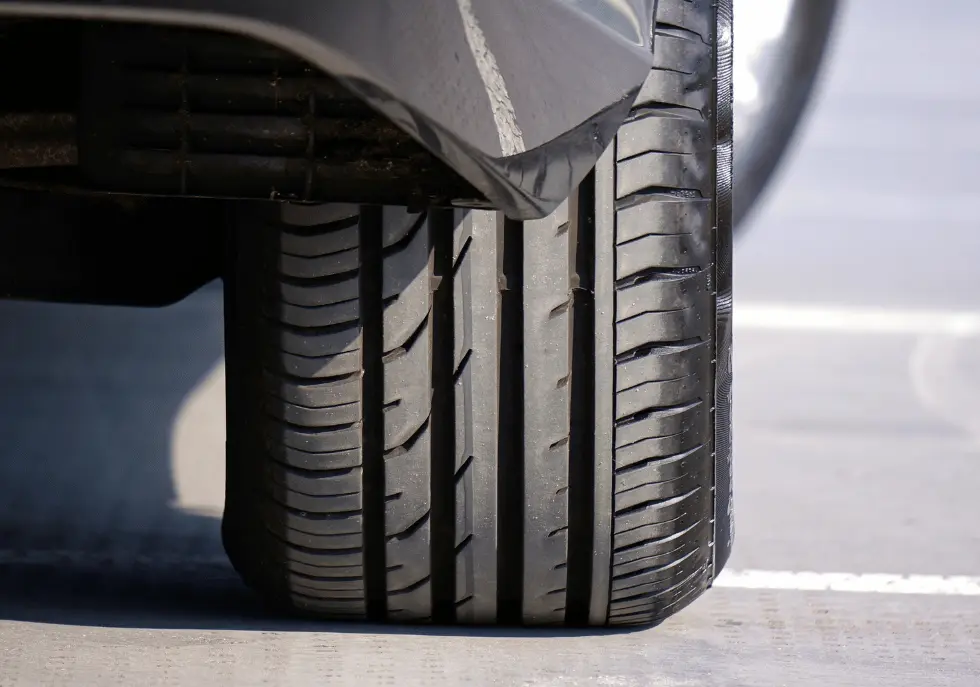
Tread is the pattern of grooves cut into the rubber. Its main job in this country, where it rains roughly nine months of the year, is to shift water out from under the tyre so the rubber can actually grip the road.
When it is chucking it down, each tyre can clear something like a gallon of water every second. That only works if the grooves are deep enough. As the tread wears down, less water gets moved, and you start skating across the surface instead of gripping it. That is aquaplaning, and it is genuinely terrifying when it happens.
So the law is not being fussy for the sake of it. Worn tyres are one of the most common causes of losing control in the wet.
The legal limit, explained simply
The rule comes from the Road Traffic Act 1988 (Section 41A, if you like to know your references). Here is what the legal tyre tread depth UK rules actually mean for a normal driver:
For cars, vans and light trailers: the minimum tyre tread depth UK law sets is 1.6mm, across the central three quarters of the tyre, around the full circumference.
That “central three quarters” and “full circumference” bit matters. Your tyre could look grand in the middle but be worn on one edge, and that still makes it illegal. Tyres often wear unevenly, so one bald strip is enough to land you in bother. This is the tyre tread depth legal limit for the vast majority of vehicles on UK roads, and the uk legal tyre tread depth figure has stayed at 1.6mm for cars for years. Put simply, the legal depth of tyre tread uk law demands is 1.6mm, no less.
For motorcycles, large vehicles and passenger carrying vehicles: the minimum is 1mm, not 1.6mm. A lot of guides forget to mention this, so if you are on a bike, your number is different. The HGV tyre tread depth minimum is also 1mm by law, though the industry strongly recommends running well above that.
A quick note on the spare: there is no law forcing you to carry a spare at all. And if you do carry one, it does not have to be legal while it is sitting in the boot. It only needs to be road legal once it is actually fitted and you are driving on it.
How to measure tyre tread depth (three ways)
You do not need a garage for this. Here are the three methods for how to measure tyre tread depth yourself, easiest first.
1. The tyre tread depth 20p test
Grab a 20p coin. Shove it into one of the main grooves. If the outer band of the coin (the raised rim around the edge) is hidden, you are fine. If you can see that band, get your tyres looked at. The tyre tread depth 20p method is the one most UK drivers know.
Do this at a few points around each tyre and across its width, not just one spot, because of that uneven wear we mentioned.
But here is the thing nobody tells you. The outer band of a 20p is about 3mm wide, not
1.6mm. So the 20p test is really telling you whether you are above or below 3mm, which is the recommended replacement point, not the actual legal limit of 1.6mm.
In simple terms: if you can see the band on the coin, you are not necessarily breaking the law yet, but you are in the zone where you should be measuring properly and thinking about new rubber. Loads of websites tell you to do the 20p test as if it checks the legal limit. It does not. It checks the safety recommendation, which is stricter. Handy to know so you are not panicking or, worse, driving around thinking you are fine when you are borderline.
2. The tread wear indicators
Look inside the grooves and you will spot little raised bars of rubber, usually with a small arrow or symbol on the tyre wall pointing to them. When the tread wears down flush with those bars, you are at or below the legal limit. If the surface of the tyre is level with the bars, it is time for new ones, no coin required.
3. A tyre tread depth gauge
This is the accurate one. A tyre tread depth gauge costs a few quid from any motor factor or online. It gives you an actual millimetre reading so there is no guessing. If you want to know exactly where your car tyre tread depth stands, this beats the coin every time. For anyone who wants an exact car tyre tread depth uk reading before a long motorway run, a gauge is well worth the couple of quid. Checking your uk car tyre tread depth this way takes seconds and removes all the guesswork.
Tyre tread depth chart: what each reading means
Here is a quick tyre tread depth chart so you can see at a glance where you stand once you have a reading.
| Tread depth | What it means | What to do |
| 7mm to 9mm | Brand new tyre | Nothing, you are sorted |
| 4mm to 6mm | Plenty of life left | Keep an eye on it |
| 3mm | Safety experts say start planning | Budget for replacements soon |
| 1.7mm to 2.9mm | Legal, but wet grip dropping off fast | Replace sooner rather than later |
| 1.6mm | The absolute legal limit | Replace now |
| Below 1.6mm | Illegal and unsafe | Do not drive on it, replace immediately |
Keep this handy, because knowing the number is only useful if you know what to do about it.
What brand new tyre tread depth looks like
People often ask what they are starting from. The brand new tyre tread depth on a fresh tyre is usually somewhere between 7mm and 9mm, depending on the make, model and whether it is a summer, winter or all season tyre. So the new tyre tread depth UK drivers get from the factory gives you a good few years of wear before you are anywhere near the limit, assuming even wear and sensible driving.
What it costs you if you get it wrong
This is where people’s eyes widen.
- Up to £2,500 fine per tyre.
- 3 penalty points per tyre.
Per tyre. So if all four are illegal, in theory you are looking at up to £10,000 and 12 points, which on its own is enough to lose your licence through totting up.
In the real world you are more likely to get a single tyre pulled up and a fixed penalty, but the point stands: this escalates fast when more than one tyre is gone. Getting caught below the legal limit for tyre tread depth is not a slap on the wrist.
The bit most drivers completely overlook: your insurance
Here is the one that actually costs people the most, and it is barely mentioned anywhere. If you have an accident and illegal tyres are found to have played a part, your insurer can refuse to pay out. Suddenly the £80 you saved by not replacing a tyre turns into a written off car you have to fund yourself, plus any damage you caused to someone else.
For most drivers, that risk is a far bigger deal than the fine. Bald tyres are not where you want to be saving money.
MOT tyre tread depth rules
Your tyres get checked properly once a year at the MOT, and they are one of the top reasons cars fail. The MOT tyre tread depth minimum is the same 1.6mm legal figure. Here is what the tester is actually looking at:
- Tread depth below 1.6mm is a straight fail.
- Sidewall damage: lumps, bulges or tears from the tyre’s structure starting to fail. That is a fail.
- Cuts and splits: deep ones that expose the internal cords fail. Smaller ones might just get an advisory.
- Wrong or mismatched tyres: different tyre types on the same axle can fail you.
- TPMS: if your car has a tyre pressure monitoring system and the warning light is telling you it is faulty, that is an MOT fail in itself.
- Pressure: tyre pressure is not formally tested, but a visibly flat looking tyre can still fail you.
What does an MOT tyre advisory actually mean?
This one comes up constantly, so let us clear it up properly.
When your tyres are getting low but are still legal, the tester writes an advisory rather than a fail. You will see wording like:
“Tyre worn close to legal limit / worn on edge (5.2.3(e)).”
In plain English, that means: your tyres still have enough tread to be legal today, but they are on the way out and will likely be a fail by next year if you do nothing. The reference code (like 5.2.3(e)) is just the official DVSA category for that defect. It is not a fine, it is not a fail, it is a nudge.
Real talk from doing this every day: an advisory is basically a countdown. We have lost count of the number of drivers who ignored a “worn close to legal limit” advisory in, say, October, then rang us in a panic in January after failing the following MOT or getting caught out in bad weather. If you have an advisory on tread, treat it as “sort this within a few months,” not “ignore until it fails.”
Is 3mm the real limit, or is that just garages upselling?
Fair question, and a suspicious one plenty of drivers have. You bring the car in, they tell you the tyres are “getting low” at 3mm, and you wonder if they are just after a sale.
Here is the honest answer. 3mm is not a legal requirement. You are completely within the law down to 1.6mm. But 3mm is a genuine safety recommendation from tyre safety bodies, and it is backed by actual testing, not sales patter.
Testing by the UK research organisation MIRA found that once you drop below 3mm, wet braking distances get dramatically worse. The gap between a tyre worn to 3mm and one worn to 1.6mm can be as much as 44% longer stopping distance in the wet. In real numbers, a car at the legal 1.6mm minimum can take roughly 17 metres longer to stop from 50mph in the wet than a car on fresh tyres. That is more than three car lengths. On a motorway in the rain, that is the difference between a near miss and a proper shunt.
So no, it is not just upselling. It is legal to run down to 1.6mm, but you are trading away a chunk of your wet weather safety to do it. Whether that trade is worth it is your call, but at least now you know the actual reason behind the 3mm figure.
The questions UK drivers actually ask
Is 2mm tread legal?
Yes, 2mm is legal, since it is above the 1.6mm minimum. But it is below the 3mm safety recommendation, so you are in the “start budgeting for new tyres” zone.
Can I drive with just one illegal tyre?
No. Each tyre has to be legal on its own. One illegal tyre is an offence and can cost you the fine and points for that tyre.
Do all four tyres need to be legal, or just the front two?
All four. Every tyre fitted to the car has to meet the minimum. The UK tyre tread depth rules apply to each tyre individually.
How often should I check my tread?
Roughly every two weeks, and always before a long journey. Takes ten seconds with a coin.
How much tread do brand new tyres have?
Usually somewhere between 7mm and 9mm, depending on the tyre and whether it is a summer, winter or all season type.
What to do if your tyres are below the limit
If you have done the coin test, seen the outer band, and a proper check confirms you are at or under the limit, do not keep driving on them any longer than you have to, especially in the wet.
You have got two options. Book into a garage, which means arranging a time, getting there and waiting about. Or have someone come to you and swap them where the car is sitting, on your drive, outside your work, or at the roadside if you have been caught out.
That second option is what we do. Our mobile fitters come to you and can usually have a fresh tyre fitted in 30 to 60 minutes, wherever you are in the UK. No garage trip, no hanging about in a waiting room reading three year old magazines.

If your tyres have crept below the line, or you have got an MOT advisory hanging over you and you would rather sort it than gamble on next winter, get in touch and we will come to you.
Legal figures in this guide (tread limits, fines, penalty points) reflect UK law at the time of writing. Rules can change, so always check the current position on gov.uk if you need certainty for your own situation.