


Are Part Worn Tyres Legal? UK Rules, Safety and Lifespan Guide
Yes, part worn tyres are legal to sell and use in the UK, but only when they meet a specific set of legal requirements. The law does not ban second-hand tyres outright. Instead, it sets minimum standards for tread, condition and markings that every part worn tyre must meet before it can be sold.
That is an important distinction. A tyre being legal to sell is not the same as it being the right choice for your car, or as good value as it looks. This guide walks through the actual UK rules, what genuine risks look like, how to check a part worn tyre yourself, and how long you can realistically expect one to last.
Are Part Worn Tyres Legal in the UK?
Part worn tyres can be sold and fitted legally in the UK, provided they comply with the Motor Vehicle Tyres (Safety) Regulations 1994. This law sets out the minimum tread, condition and marking standards a part worn tyre must meet before it is offered for sale. A tyre that fails to meet these standards is illegal to sell, regardless of its price or appearance.
Being legal, though, only tells you the tyre cleared a minimum bar at the point of sale. It does not tell you how the tyre was previously used, how it has aged, or whether it suits your vehicle. Those things still fall to the buyer to check, which is why the rest of this guide matters just as much as the legal answer.
Are Part Worn Tyres Legal to Sell?
Sellers can legally supply part worn tyres, but the Motor Vehicle Tyres (Safety) Regulations 1994 make it a criminal offence to sell one that does not meet the required standards. According to official Business Companion guidance, written for Trading Standards, every part worn tyre offered for sale must meet rules covering both its physical condition and its markings.
What sellers must check before selling
A part worn tyre must not have:
- Any cut deeper than 25mm or 10% of the tyre’s section width (whichever is greater) that reaches the ply or cord
- Any lump, bulge or tear caused by separation or partial failure of the structure, inside or out
- Any ply or cord exposed, internally or externally
- Any penetration damage that has not been properly repaired
On top of that, the original tread grooves must still be at least 2mm deep across the full width of the tread and all the way round the tyre. That is a higher bar than the 1.6mm minimum that applies to tyres already in use, which trips up a lot of buyers who assume the two figures are the same.
Why markings matter
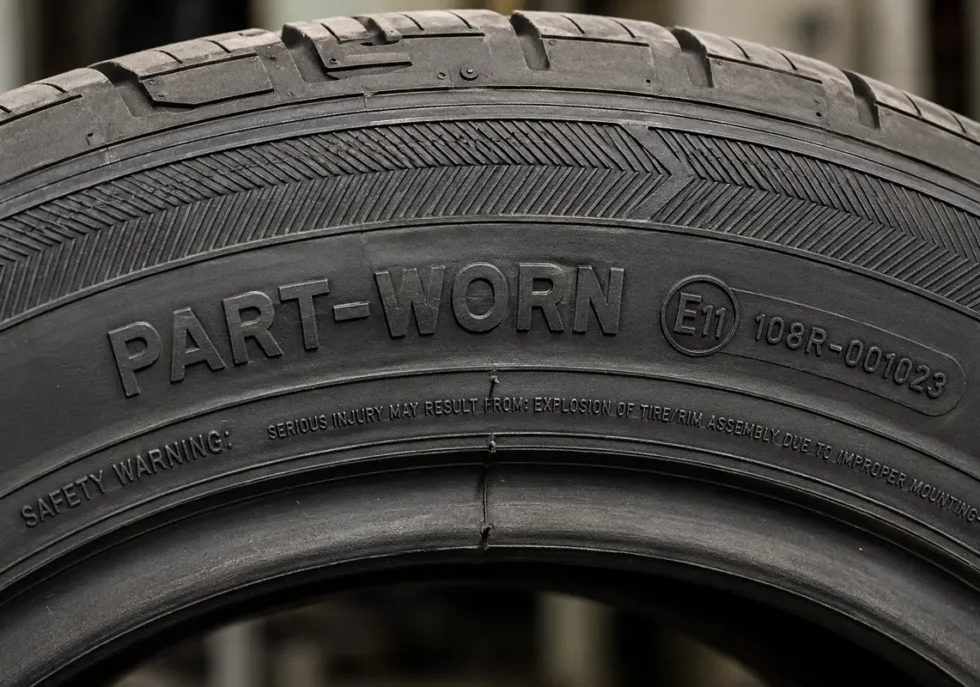
Every part worn tyre, aside from retreads, must carry its original ECE approval mark (for example E11) and its speed and load rating, moulded in at the factory. On top of that, the tyre must be permanently marked “PART-WORN” in upper case letters at least 4mm high, positioned next to the approval mark. This cannot be hot-branded or cut into the tyre. It is usually a cold-vulcanised rubber label.
Retreaded part worn tyres have their own marking rules, including the word “RETREAD” moulded into the sidewall alongside the relevant approval marks.
What happens when a tyre fails to meet the requirements
If a tyre does not meet these conditions, it is illegal to offer it for sale as part worn, even if it is sitting on a rack rather than fitted to a car. It is also illegal for a trader to have unsafe tyres in stock intended for sale. Trading Standards enforces these rules and can prosecute sellers who breach them.
A reputable seller should be able to show you the PART-WORN marking, let you inspect the tyre before you buy, and answer questions about where it came from. If a seller cannot or will not do any of that, treat it as a warning sign rather than a technicality.
Legal to Sell Does Not Automatically Mean Ideal to Buy
This is the single most useful distinction in this guide, and it is worth separating into four separate ideas.
Legal means the tyre meets the minimum requirements set out in the 1994 Regulations at the point of sale.
Safe means the tyre is in a physical condition suitable for continued use, with no hidden structural damage.
Suitable means the tyre is the correct size, load rating and speed rating for your specific vehicle and how you drive it.
Good value means the tyre’s remaining service life and condition genuinely justify its price compared with a new or budget alternative.
A tyre can tick the first box and still fall short on the others. Two part worn tyres can carry identical tread depth readings and identical legal markings, yet have completely different histories, because one spent its life on a gently driven runabout and the other spent years on a vehicle that was regularly overloaded or under-inflated. The law cannot see that history. Only a careful inspection can get you closer to it.
Are Part Worn Tyres Safe?
Whether a part worn tyre is safe depends entirely on that individual tyre, not on the category as a whole. A tyre’s safety is shaped by its age, how it was previously driven, whether it has been repaired, how it has been stored, and whether any damage is visible on close inspection.
This is different from asking whether a tyre is legal. Two tyres with the same 4mm of tread and the same PART-WORN marking can have very different pasts. One might have led an easy life on a car that was serviced regularly and never driven hard. The other might have been run under-inflated for months, taken a hard kerb impact, or been repaired badly before being sold on. From the outside, they can look almost identical.
That unknown history is the real source of uncertainty with part worn tyres, more than the tread number on its own. It does not mean every part worn tyre is a gamble. It means the buyer’s job is to look past the tread depth and check the things that history leaves behind, which the next section covers.
Dangers of Part Worn Tyres
The genuine risks with part worn tyres are not really about the tyre being “used”. They are about whether that specific tyre has been properly inspected and is actually suitable for the car it is going on.
Some of the more serious issues to be aware of include:
- Hidden internal damage from a previous impact or pothole strike, which is not visible from the outside
- Poor quality repairs that do not meet British Standard BS AU 159 for tyre repairs
- Sidewall cracking, often linked to age or long periods of exposure to sunlight and weather
- Uneven wear, which can point to alignment or suspension issues on the previous vehicle
- Unknown inflation history, since a tyre run consistently under-inflated wears and ages differently on the inside
- Incorrect specification, such as the wrong load or speed rating for your vehicle
Some of these problems are genuinely hard for an untrained eye to spot. A tyre can look sound at a glance and still have compromised internal structure from a previous impact. That is the main reason a professional inspection is worth having if you are unsure about a tyre’s history, rather than relying on tread depth and a visual check alone.
How Long Do Part Worn Tyres Last?
There is no fixed figure for how long a part worn tyre will last, and any guide that gives you one is guessing. Remaining lifespan depends on how much tread was already used, how the tyre was driven before you bought it, its age, its current condition, and how you drive and maintain it going forward.
It helps to separate two different ideas: a tyre’s total lifespan across its whole life, and its remaining lifespan from the point you fit it. A part worn tyre with 6mm of tread and a recent manufacture date may have more usable life left than another part worn tyre with a similar 6mm reading but a date code showing it was made seven or eight years ago, because rubber hardens and degrades with age regardless of how much tread is left.
This is why tread depth on its own is not a reliable way to judge a part worn tyre’s remaining life. A tyre with plenty of tread but old, hardened rubber can offer less safe mileage than one with slightly less tread but younger, more supple rubber and a clean history. Your own driving style, tyre pressure checks and road conditions after fitting will also affect how far any tyre, part worn or new, actually goes.
Part Worn Tyres vs New Tyres
| Factor | Part Worn Tyres | New Tyres |
|---|---|---|
| Previous use | Already used on the road | No previous road use |
| Remaining tread | Varies, minimum 2mm at sale | Usually full tread from new |
| Remaining lifespan | Harder to predict, history unknown | More predictable, but still depends on use |
| Purchase price | Usually lower | Usually higher |
| Known history | Often limited or unverifiable | Clear, as a new product |
| Age | Must be checked via date code | Manufacture date still worth checking |
| Condition | Requires careful inspection | Supplied in new condition |
Neither option is automatically the right call for every driver. A part worn tyre with a strong, verifiable history can be a sensible way to save money on a car that does low mileage. A new tyre removes the guesswork entirely, which matters more if you cover long distances or drive at higher speeds regularly.
Part Worn Tyres vs Budget New Tyres
The comparison drivers usually skip is part worn against budget new tyres, and it is often the more useful one. Before deciding, compare:
- The actual price difference, not just the headline figures
- Remaining tread and the tyre’s manufacture date
- The brand and model, since budget new tyres vary a lot in quality
- Any warranty or support the retailer offers
- How the tyre will be used, including mileage and typical driving conditions
Neither a budget new tyre nor a part worn tyre is automatically the better buy. If a decent budget tyre costs only a little more than a part worn one with an uncertain history, the certainty of a new tyre is often worth the extra. If the part worn tyre is significantly cheaper, has a recent date code, and has been properly inspected, it can still represent genuine value.
How to Check a Part Worn Tyre Before Buying
Check the tread:
Look for even wear across the full width of the tyre, not just a good reading in the centre. Uneven wear can point to problems that go beyond the tyre itself.
Inspect the sidewalls:
Run your eyes and a hand around the full sidewall, looking for cracks, cuts, bulges or any distortion. Sidewall damage is one of the clearest signs a tyre should be avoided.
Look for cracks and damage on the tread surface:
Check for cracking in the grooves, embedded stones or debris, and any abnormal wear pattern that does not match normal road use.
Check the manufacture date:
Every tyre carries a four-digit date code. Knowing how to read it, covered below, is one of the most useful checks you can do on a part worn tyre.
Check the required markings:
Confirm the tyre carries its original approval mark, its speed and load rating, and a clear “PART-WORN” marking at least 4mm high next to the approval mark. If any of these are missing, the tyre should not be for sale.
Check the specification:
Confirm the size, load rating and speed rating match what your vehicle needs. Fitting the wrong specification is a common and avoidable mistake.
Ask about previous repairs:
A previously repaired tyre is not automatically a problem, but the repair needs to meet British Standard BS AU 159. Ask the seller directly and be cautious if they cannot answer.
Have it professionally inspected if you are unsure:
If you are buying a tyre with an uncertain history or you are not confident checking it yourself, a professional inspection before or immediately after fitting is a sensible extra step.
How to Read the Tyre Date Code
Every tyre has a four-digit code moulded into the sidewall showing when it was made. For example, a code reading 3522 means the tyre was manufactured in week 35 of 2022.
This is a manufacture date, not an expiry date, but it matters more for part worn tyres than new ones. A new tyre’s age is usually only a few months. A part worn tyre could be several years old before you even take previous road use into account, so checking this code gives you information the tread depth alone cannot.
How Old Is Too Old for a Part Worn Tyre?
There is no single legal age limit that applies to ordinary car tyres. Rubber ageing depends on manufacture date, but also on storage conditions, previous use and environmental exposure, so two tyres of the same age can be in very different states.
The picture is different for heavy vehicles. Since 1 February 2021, it has been illegal to fit tyres aged over 10 years to the front steering axle of goods vehicles over 3,500kg, buses and coaches, and to any single wheel position on a minibus. This rule followed years of campaigning after a tyre-related coach crash, and DVSA now checks tyre age as part of both the annual test and roadside enforcement for these vehicle types. It does not apply to ordinary cars, so it is not a figure you can apply universally, but it shows that age genuinely matters for tyre safety once you look past tread depth alone.
For a car tyre, rather than relying on age in isolation, look at the manufacture date alongside the tyre’s actual physical condition, particularly sidewall cracking and general stiffness of the rubber.
Part Worn Tyres With Plenty of Tread
It is a common assumption that a part worn tyre with lots of tread left must be a safe buy. Tread depth is one useful indicator, but it does not tell the whole story.
A tyre can have 6mm or 7mm of tread remaining and still have sidewall cracking, internal damage from a previous impact, or rubber that has hardened with age. None of that shows up on a tread depth gauge. This is exactly why the fuller inspection checklist above matters more than a single tread measurement when you are assessing a part worn tyre.
Can Part Worn Tyres Pass an MOT?
A part worn tyre can pass an MOT without issue, provided it meets the same standards the DVSA MOT inspection manual applies to any tyre. The tester is not looking at whether a tyre started life as new or part worn. They are checking tread depth, sidewall condition, structural integrity and whether the correct tyre is fitted for the vehicle.
Passing an MOT is not the same as a guarantee that a tyre will remain suitable for the rest of the year. An MOT is a snapshot of the vehicle’s condition on the day of the test, so tyre condition should still be checked regularly between tests, particularly with a part worn tyre whose full history you may not know.
Are Part Worn Tyres Worth Buying?
There is no universal yes or no answer here. Whether a part worn tyre is worth buying depends on your budget, how many miles you cover, the type of driving you do, and how confident you are in the tyre’s condition and history.
If the price gap between a suitable new tyre and a part worn one is small, the extra certainty and remaining life of the new tyre often make it the stronger choice. If the part worn tyre is significantly cheaper, has a recent manufacture date, clear markings and passes a proper inspection, it can be a reasonable way to manage cost, particularly on a low-mileage vehicle.
Are Part Worn Tyres Safe for Motorway Driving?
Motorway and long-distance driving puts more sustained load and heat into a tyre than short urban trips, so the margin for error is smaller. If you are considering part worn tyres for a car used mainly on motorways, pay particular attention to correct tyre pressure, the right load and speed rating for your vehicle, tread evenness, and any sign of damage or age related deterioration. A professional inspection before committing to regular motorway use is a sensible precaution rather than an overreaction.
Part Worn Tyres for Vans
Vans and light commercial vehicles often carry variable loads, which changes tyre pressure requirements and wear patterns compared with a typical passenger car. A part worn tyre suited to a lightly loaded car is not automatically suitable for a van that regularly carries near its maximum payload. Always confirm the load rating matches your van’s actual use, rather than assuming a passenger car tyre check applies in the same way.
Common Problems With Part Worn Tyres
| Problem | Why It Matters | Recommended Action |
|---|---|---|
| Sidewall crack | Possible rubber deterioration | Get it professionally inspected |
| Bulge | Possible internal structural damage | Do not use the tyre |
| Exposed cord | Serious structural damage | Replace the tyre |
| Uneven wear | May point to alignment or pressure issues | Investigate the cause |
| Unrecorded repair | Previous damage may affect the tyre’s integrity | Get a professional assessment |
| Very old manufacture date | Greater risk of age related hardening | Check physical condition closely |
| Incorrect specification | May not suit your vehicle | Do not fit it |
| Damaged tread | Potential safety issue | Get a professional assessment |
Conclusion
Part worn tyres can be legal to sell and use in the UK, but legality is only the starting point. The Motor Vehicle Tyres (Safety) Regulations 1994 set out clear requirements for tread, condition and markings, and a tyre that does not meet them should never be sold. Beyond that legal minimum, the tyre’s age, previous use, damage, repair history and specification all decide whether it is genuinely suitable for your car.
Tread depth alone will not tell you that story. If you are ever unsure whether a part worn tyre is right for your vehicle, have it checked by a qualified tyre professional rather than relying on price or a quick glance at the tread.
If you’d like a part worn or replacement tyre properly inspected and fitted at your home or workplace, TyresFlow’s mobile tyre fitting service covers the UK with same-day availability.
This article has been reviewed by the TyresFlow tyre safety team, drawing on hands-on experience fitting, inspecting and assessing both part worn and new tyres for drivers across the UK. Our technicians regularly check tyre condition, tread depth, sidewall damage, age and other safety factors in real-world fitting situations, helping ensure our guidance reflects practical tyre safety as well as current UK requirements.
Frequently Asked Questions
Are part worn tyres legal in the UK?
Yes. Part worn tyres are legal to sell and use in the UK when they meet the Motor Vehicle Tyres (Safety) Regulations 1994. This covers minimum tread depth, structural condition and required markings, including the “PART-WORN” label. A tyre that fails to meet these standards is illegal to sell.
Are part worn tyres legal to sell?
Yes, provided the seller meets the legal requirements around condition and markings. It is a criminal offence under the 1994 Regulations to knowingly sell a part worn tyre with damage, insufficient tread, or missing markings. Trading Standards enforces these rules.
Are part worn tyres safe?
Safety depends on the individual tyre rather than the category as a whole. Age, previous use, repairs, storage and visible condition all affect whether a specific part worn tyre is safe. Two tyres with identical tread can have very different histories.
What are the dangers of part worn tyres?
The main risks are hidden internal damage, poor quality previous repairs, sidewall cracking, uneven wear and unknown inflation history. These issues are not always obvious without a close inspection, which is why checking beyond tread depth matters.
How long do part worn tyres last?
There is no fixed lifespan. Remaining life depends on how much tread was already used, the tyre’s age, its condition, and how it is driven and maintained after fitting. Age and condition can matter as much as tread depth.