


Winter Tyres vs Summer Tyres: Which Is Best for UK Drivers?
Our technicians at TyresFlow, with hands on experience fitting and inspecting winter, summer and all season tyres across the UK. Their practical experience with changing UK weather and road conditions informs the guidance provided in this article.
When it comes to winter tyres vs summer tyres, there is no single answer that suits every UK driver. Winter tyres are built with a softer compound and a tread designed for cold, wet and snowy conditions, while summer tyres use a firmer compound suited to warmer temperatures and dry or wet roads above around 7°C. Which one is right for you depends on where you live, how you drive and how often you face genuinely cold or icy conditions.
This guide compares winter and summer tyres in plain terms: how they’re made, how they perform, how to tell which ones are currently on your car, and what UK law actually says about using them. We’ll also look at all-season tyres as a middle-ground option for drivers who don’t want to swap tyres twice a year.
Winter vs Summer Tyres: What’s the Difference?
The core difference between winter and summer tyres comes down to two things: the rubber compound and the tread design.
Winter tyre compounds are formulated to stay flexible in low temperatures. A summer tyre compound, by contrast, starts to stiffen as temperatures drop, which reduces its ability to grip the road surface. Manufacturers including Michelin commonly describe winter tyre compounds as becoming more effective once temperatures fall consistently below around 7°C, while summer compounds are designed to perform at their best above that point.
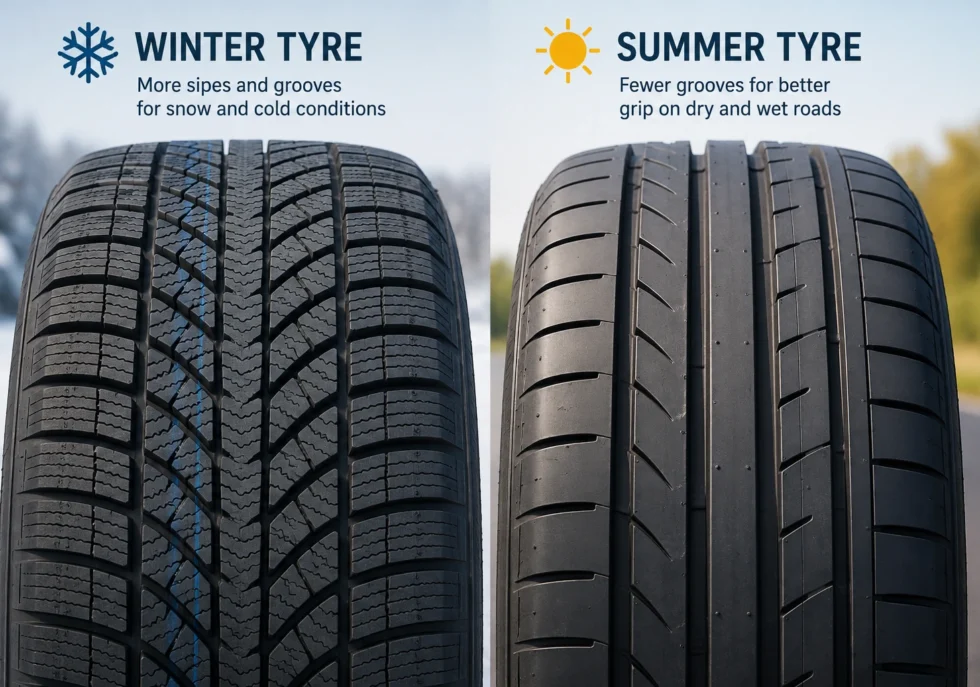
Tread design tells a similar story. Winter tyres have more grooves and a much higher number of small slits, called sipes, cut into the tread blocks. These sipes bite into snow and help channel away water and slush. Summer tyres have a shallower, more solid tread pattern built to maximise contact with dry tarmac while still clearing water effectively in the rain.
Neither tyre is “better” in an absolute sense. A summer tyre in July and a winter tyre in a hard frost are both doing the job they were designed for. The problems start when the conditions and the tyre type don’t match.
What Are Winter Tyres?
Winter tyres are tyres engineered specifically for cold weather driving, including but not limited to snow. They’re sometimes mistakenly thought of as “snow tyres” only, but their benefit runs wider than that.
Key features of winter tyres include:
- A softer rubber compound that stays pliable in low temperatures, helping the tyre maintain grip when a summer tyre would start to harden.
- Dense sipes cut into the tread blocks, which create extra biting edges for grip on snow, slush and cold wet roads.
- Deeper grooves, which help channel away slush and water and reduce the chance of the tread packing solid with snow.
- A tread pattern designed to give confidence-inspiring grip on cold, wet or icy surfaces, rather than pure high-speed dry handling.
Because the compound is softer, winter tyres can feel less precise on warm, dry roads than a dedicated summer tyre. They also tend to wear faster in warmer conditions, since the softer rubber isn’t designed to cope with heat generated at higher temperatures. This is one reason manufacturers recommend switching winter tyres off the car once consistently mild weather returns, rather than running them all year.
What Are Summer Tyres?
Summer tyres, sometimes just called “standard” tyres, are what most UK cars are fitted with as new. They are not restricted to summer use only. The name refers to the compound and tread being optimised for a broader temperature range that includes most of the UK’s spring, summer and autumn conditions, and often much of a typical UK winter too.
Summer tyres are built around:
- A firmer rubber compound that holds its shape and responsiveness in warmer temperatures, giving precise steering feel and stable handling.
- A tread pattern with wider channels designed to evacuate water quickly, which supports strong wet-road braking and reduces the risk of aquaplaning.
- Consistent dry-road grip and handling, since the compound doesn’t need to compromise for extreme cold.
The trade-off is that as temperatures fall towards freezing, a summer tyre’s compound begins to stiffen. This reduces the contact patch’s ability to flex into the road surface, which can extend braking distances and reduce grip, particularly on cold, wet or icy roads.
Winter Tyres vs Summer Tyres: Key Differences
| Feature | Winter Tyres | Summer Tyres |
|---|---|---|
| Rubber compound | Stays flexible in cold temperatures | Firmer, designed for warmer temperatures |
| Tread design | Dense grooves and sipes for snow and slush | Wider channels focused on water evacuation |
| Cold weather (below ~7°C) | Stronger grip and shorter braking distances | Compound stiffens, grip and braking can suffer |
| Warm weather | Can wear faster, less precise handling | Designed for confident dry and warm-road handling |
| Snow and ice | Built with these conditions in mind | Not designed for snow or ice performance |
| Wet roads | Capable, depending on temperature | Strong performance in the conditions they’re built for |
| Dry roads | Can feel less responsive in warm weather | Generally more precise and stable |
| Typical UK suitability | Useful for drivers regularly facing cold, rural or icy conditions | Suitable for most UK drivers for most of the year |
Actual performance always depends on the specific tyre brand and model, the vehicle, the road surface and how worn the tyre already is, so treat this table as a general guide rather than a guarantee for any particular tyre.
How Do I Know If My Tyres Are Summer or Winter?
If you’re not sure which type of tyre is currently fitted to your car, there are a few practical ways to check.
Check the sidewall markings. Look for “M+S” or “M&S” (Mud and Snow), and separately for the 3PMSF symbol, a small snowflake sitting inside an outline of three mountain peaks. These are different markings and shouldn’t be treated as interchangeable. M+S is largely a self-certified label based on tread pattern, with no independent performance test behind it. The 3PMSF symbol is only awarded once a tyre has passed a standardised snow traction test, so it’s the stronger indicator of genuine winter performance. A tyre can carry M+S without 3PMSF, and this is common on some all-season tyres too.
Check the tread. Winter tyres typically show a denser pattern of thin sipe cuts across the tread blocks compared with a summer tyre. This isn’t a foolproof method on its own, since all-season tyres sit somewhere in between, but it can support what you find on the sidewall.
Check the tyre brand and model. Every tyre has a model name printed on the sidewall alongside its size. Searching the exact model, for example “Continental WinterContact” or “Michelin Primacy”, will confirm whether it’s a dedicated winter, summer or all-season design.
Ask a professional. If the markings are unclear or the tyre is heavily worn, a tyre technician can confirm the tyre type in a couple of minutes during a routine check.
Quick Reference: How to Tell the Difference
| What to check | Winter tyre | Summer tyre |
|---|---|---|
| Sidewall markings | Often carries 3PMSF and/or M+S | Usually has no winter-specific marking |
| Tread pattern | Dense grooves and sipes | Wider channels, fewer sipes |
| Compound feel | Softer to the touch | Firmer to the touch |
| Snow performance | Designed for it | Not designed for it |
Don’t rely on appearance alone. Sidewall markings and the exact tyre model are the most reliable way to confirm what’s fitted to your car.
Winter or Summer Tyres UK: Which Should You Choose?
The right choice depends far more on your driving conditions than on the calendar.
Winter tyres may suit you if:
- You regularly drive in a rural area, on hills, or on roads that aren’t gritted quickly.
- You do early morning or late evening journeys when frost and ice are more likely.
- You live somewhere in the UK, such as parts of Scotland, northern England or Wales, where snow and prolonged cold spells are more common.
- You want a dedicated set built specifically for confidence in cold conditions.
Summer tyres may be enough if:
- You mainly drive in towns and cities on well-gritted, well-used roads.
- You rarely encounter snow or ice, even in a typical UK winter.
- You’d rather run one set of tyres year-round without the cost or hassle of switching.
Not every UK driver needs a dedicated winter set. Someone commuting on gritted A-roads in the Midlands has very different needs from someone driving unclassified rural roads in the Scottish Highlands.
Are Winter Tyres Worth It in the UK?
This is genuinely a “it depends” question, and a balanced answer is more useful than a blanket recommendation.
In favour of winter tyres: they can improve grip, braking and handling in cold, wet, icy or snowy conditions, which matters if you regularly drive in those conditions or simply want extra peace of mind during winter months. For drivers on rural roads, in hilly areas, or those who do a lot of early-morning driving, the safety margin can be meaningful.
Against a dedicated winter set: buying a second set of tyres, and ideally a second set of wheels to make swapping easier, is a real cost. You’ll also need somewhere dry and cool to store the tyres you’re not using, and you’ll need to remember to switch them at the right point in the year rather than by a fixed date.
For many UK drivers who mainly stick to gritted main roads and rarely see snow, a good-quality summer tyre kept well within its tread limits, or an all-season tyre, may be entirely sufficient. For drivers who regularly face genuinely cold or snowy roads, a dedicated winter set is a reasonable investment in safety.
Performance in Cold, Wet, Snow and Dry Conditions
Cold and icy conditions. This is where the compound difference matters most. A winter tyre’s softer rubber keeps flexing and gripping as temperatures drop, while a summer tyre’s compound stiffens, reducing the contact patch’s ability to mould around small imperfections in the road. This can extend braking distances on cold roads, even ones that look dry.
Wet weather. Both tyre types are designed to handle rain, just with different priorities. Summer tyres use wider channels to shift large volumes of water quickly, which is a strength on motorways in heavy rain. Winter tyres also clear water reasonably well, but their real advantage in wet weather shows up when the temperature is low enough that a summer tyre’s compound would already be stiffening.
Snow and ice. Winter tyres are clearly built for this. The dense sipe pattern bites into loose snow and helps maintain traction under acceleration, braking and cornering. Summer tyres are not designed with this in mind and will generally struggle more in these conditions, though how a specific car copes still depends on tread depth, tyre pressure and driving style.
Dry roads. In warm, dry conditions, summer tyres typically offer more precise steering feel and stable handling, since the firmer compound holds its shape better under load. Winter tyres can feel slightly vaguer in these conditions and may wear more quickly, since the softer compound isn’t built to cope with the heat generated on warm tarmac.
No braking distance or grip percentage figures are given here, since these vary by tyre brand, model, vehicle and testing conditions. If you want specific comparative data, check independent tyre tests from organisations such as TyreSafe or manufacturer-published results, and always check the test conditions they used.
Can You Use Winter Tyres All Year? Can You Use Summer Tyres in Winter?
Winter tyres all year round: this isn’t illegal, but it’s not recommended. In warmer weather, the softer compound wears faster and can affect handling precision, so most tyre manufacturers advise switching back to summer tyres once temperatures are consistently mild.
Summer tyres through winter: this is legal in the UK, and it’s what the vast majority of UK drivers do without issue. It’s not automatically unsafe either, provided the tyres have plenty of tread and are in good condition. The consideration is performance rather than legality. In genuinely cold, icy or snowy conditions, a summer tyre’s grip and braking performance will generally be reduced compared with a winter or all-season tyre built for those conditions.
The key distinction throughout is that legal and ideal aren’t always the same thing. It’s legal to run summer tyres all winter in the UK. Whether it’s the best choice for your specific driving depends on the conditions you actually face.
Are Winter Tyres Legal in the UK?
Yes, winter tyres are fully legal to fit and use in the UK at any time of year, and so are summer tyres in winter. Unlike several other European countries, the UK has no law requiring drivers to fit winter tyres during colder months, and there’s no specific temperature at which switching becomes a legal obligation. You may sometimes see 7°C mentioned in relation to winter tyres; this refers to a performance threshold used by manufacturers when describing how their compounds behave, not a legal trigger point.
What the law does require, regardless of tyre type, is that every tyre meets the legal minimum tread depth of 1.6mm across the central three-quarters of the tread, around the tyre’s full circumference. This applies equally to winter, summer and all-season tyres. Tyres must also be free of cuts, bulges and other damage, correctly inflated, and appropriate for the vehicle.
Winter tyres and the MOT. The MOT test checks tread depth, general tyre condition and that tyres are correctly matched, but it doesn’t check whether a tyre is a winter, summer or all-season type, and simply having winter tyres fitted has no bearing on whether a car passes or fails. Nor does switching between summer and winter sets create any MOT issue, provided each tyre on its own meets the legal requirements.
M+S and 3PMSF markings. These sidewall symbols aren’t a UK legal requirement for private cars, though they are relevant if you’re driving in parts of Europe that do mandate winter tyres for part of the year, since many of those countries define a qualifying winter tyre by these markings.
Winter vs Summer vs All-Season Tyres
All-season tyres sit between the two, built to offer reasonable performance across a wider temperature range rather than excelling at either extreme.
What they’re good for: a single set that copes with a typical UK winter, spring, summer and autumn without needing to be swapped. Many carry the M+S marking, and a growing number now carry 3PMSF certification too, giving them a genuine, tested level of snow performance.
Their limitations: an all-season tyre generally won’t match a dedicated winter tyre’s grip in heavy snow or hard ice, and it won’t match a dedicated summer tyre’s precision and dry-road handling in hot weather. It’s a compromise rather than a replacement for either specialist tyre.
Who tends to benefit: drivers who want to avoid the cost and hassle of two tyre sets, who face mixed and moderate conditions rather than extreme winters, and who mainly drive on gritted roads with occasional cold snaps.
All-season tyres aren’t automatically the “best of both worlds” for every driver. If you regularly face serious snow and ice, a dedicated winter set will usually still outperform an all-season tyre in those specific conditions.
Should You Switch Between Winter and Summer Tyres?
Switching seasonally makes most sense for drivers who face real winter conditions regularly, since it means running the tyre best suited to the conditions at hand rather than a compromise.
If you do switch, a few practical points are worth following:
- Base the switch on the weather forecast and your local conditions, not a fixed calendar date.
- Check tyre pressure after refitting a stored set, since pressure drops over time even when a tyre isn’t in use.
- Inspect the tread depth and look for cracking or damage before refitting tyres that have been in storage.
- Follow the tyre manufacturer’s guidance on when performance changes are most noticeable for that specific tyre.
Storing seasonal tyres correctly matters for getting a full lifespan out of both sets. Keep them somewhere dry, cool and out of direct sunlight, away from oils, fuel or solvents that can degrade rubber over time. If the tyres are off the wheels, store them upright rather than stacked flat where possible, and label each tyre with its position (front left, rear right, and so on) so it goes back in the same rotation.
Final Thoughts
There’s no single tyre type that’s automatically best for every UK driver. Winter tyres are built for cold, snowy and icy conditions, with a compound and tread designed to keep working when temperatures drop. Summer tyres are built for warmer conditions, offering precise handling and reliable wet-road performance for most of a typical UK year. All-season tyres offer a middle ground for drivers who want to avoid switching but still want reasonable performance in both.
The best choice comes down to where you drive, how often you face genuinely cold or icy roads, and how much you value having a tyre built specifically for those conditions. Whichever type you choose, keeping tread depth well above the legal minimum and checking tyre condition regularly matters more to your safety than the seasonal label on the sidewall.
If you’re not sure what’s currently fitted to your car, or your tyres are due a check before winter sets in, TyresFlow’s mobile tyre fitting team can inspect, identify and replace your tyres at a location that suits you.
Frequently Asked Questions
What is the difference between winter and summer tyres?
Winter tyres use a softer compound and a denser tread pattern with more sipes, designed to stay flexible and grip in cold, snowy or icy conditions. Summer tyres use a firmer compound and a tread built for confident handling and water evacuation in warmer temperatures.
Which is better, winter or summer tyres?
Neither is universally better. Winter tyres perform better in cold, snowy or icy conditions, while summer tyres offer more precise handling in warm, dry weather. The right choice depends on your typical driving conditions, not a fixed rule.
Can I use winter tyres all year?
It’s legal, but not recommended. Winter tyres wear faster in warm weather and can feel less precise on dry roads, since the softer compound isn’t built for higher temperatures.
Can I use summer tyres in winter?
Yes, this is legal and is what most UK drivers do. Performance in cold, icy or snowy conditions will generally be reduced compared with winter or all-season tyres, so it’s a safety consideration rather than a legal one.
How do I know if my tyres are winter or summer?
Check the sidewall for M+S or 3PMSF markings, look at the tread pattern for density of sipes, or search the exact tyre model printed on the sidewall. A tyre professional can confirm it quickly if you’re unsure.
What does M+S mean on a tyre?
M+S stands for Mud and Snow. It’s a manufacturer self-certified marking based on tread pattern, with no independent performance test required, so it doesn’t guarantee the same level of winter performance as the 3PMSF symbol.
What does the 3PMSF symbol mean?
3PMSF stands for Three Peak Mountain Snowflake. It shows a snowflake inside a three-peaked mountain outline and is only awarded once a tyre has passed a standardised snow traction test, making it a stronger indicator of genuine winter performance than M+S alone.